

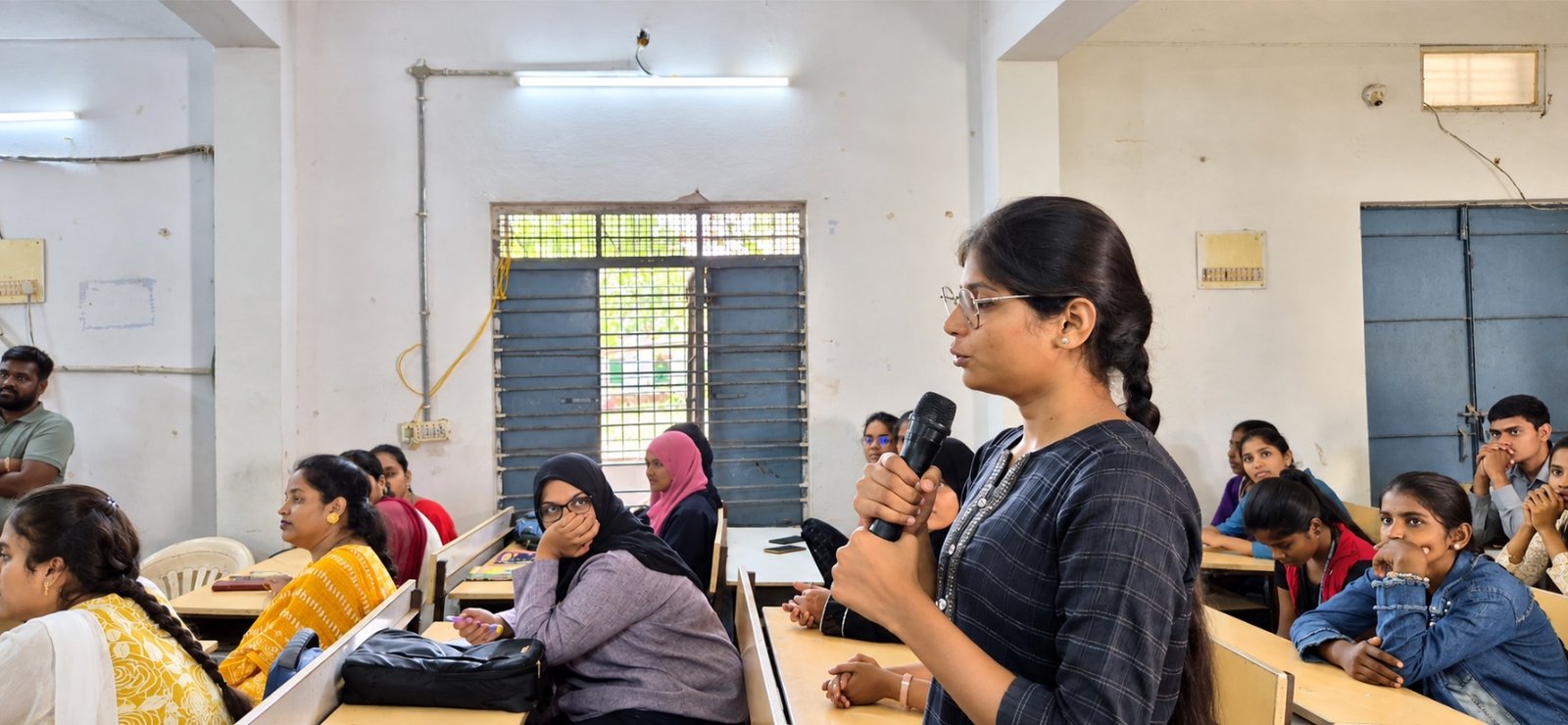
Every year, in degree colleges across the Sangareddy area and thousands of places like it, a cohort of final-year students collects a B.Com or a B.A. or a B.Sc. and discovers that the certificate answers a question no employer is asking.
The employer is asking something else. Can you hold a conversation in English for four minutes without losing the thread. Can you open a spreadsheet and do something useful in it. Can you work through a reasoning problem when someone is watching. Can you explain, in your own words, why you want this job.
None of those are taught by the degree. All of them are assessed in the interview. The distance between the two is where a great many capable rural students quietly lose three years of work.
Skill Plus exists to close that distance, and it does it in the only window that is genuinely available: the final year, while the student is still on campus.
What the gap actually looks like
Take a composite from one of our partner-college batches. Call her Sravani. Second child in the family, first to reach a degree. Strong in accounts, good marks, has never had a reason to speak English to a person rather than to an answer sheet. She has used a computer in a lab, under instruction, twice.
She is not underqualified. On paper she is exactly who a BFSI back-office team or an ITES employer is looking for. She will still be filtered out in the first eleven minutes of a walk-in, because the walk-in tests fluency and composure, and nobody has ever asked her to practise either.
Sravani’s problem is not ability. It is exposure. Exposure is a thing you can schedule.
Ten months, inside the college
Skill Plus runs for around ten months alongside the final year, in the student’s own college, using the college’s classrooms and computer labs. We chose that model deliberately. A programme that requires a rural student to travel to a training centre, pay for transport, and explain the absence at home will lose the students who need it most, and it will lose the young women first.
The curriculum has four working parts, and they run in parallel rather than in sequence:
Foundational English and communication. Not grammar drills. Speaking, repeatedly, in front of people, until the first thirty seconds of a conversation stop being frightening. This is the component that takes the longest and changes the most.
Computing. Practical, employer-relevant work on machines the students can reach — the kind of competence that is assumed rather than taught in most job descriptions.
Reasoning and aptitude. The specific thing that written screening rounds test, practised often enough that the format stops being an obstacle in itself.
Life skills and industry-facing training. Workplace behaviour, time discipline, money sense, and customised modules aligned to the sectors that are actually hiring near them. Our initial focus has been ITES and BFSI, because that is where the openings within reach of these districts have been.
Underneath all four is the part that is hardest to put in a syllabus: ten months of being treated as someone who is going to work, by adults who expect them to.
The intended outcome is employment at a starting salary in the range of Rs 2.5 to 3 lakh a year, with access to a wide employer network through the Deshpande Foundation, one of our founding partners. For a first-generation graduate from a village near Kandi, that first salary is not just an income. It is the thing that makes the next sibling's education non-negotiable.
Mr Rajabali, COO, NBSF Tweet
Selection works in both directions
We select the colleges before we select the students.
That sounds like a formality and it is not. A programme like this depends on a principal who will protect the timetable slot, faculty who do not treat it as a distraction from the exam, and a lab that is actually open when the batch needs it. Where those conditions are absent, ten months of good curriculum produces very little. So we look for institutions whose priorities line up with ours, and then we run a student selection process within them.
Within the batch, we prioritise women, students from below-poverty-line households, first-generation graduates and rural learners. These are the students for whom the gap between degree and interview is widest, and for whom closing it changes the most.
We also ask families to contribute part of the cost. This is a considered decision rather than a funding convenience. A programme that costs a household something is a programme the household follows up on, and a student whose family has invested in the attempt attends differently. Where cost would genuinely exclude a deserving student, we work it out.
This is a great reminder that financial planning isn’t just about numbers; it’s about aligning your money with your life goals. Physician Lifecycle Planning can help you make the most of your earning potential while ensuring you’re also prioritizing your well-being and quality of life.