

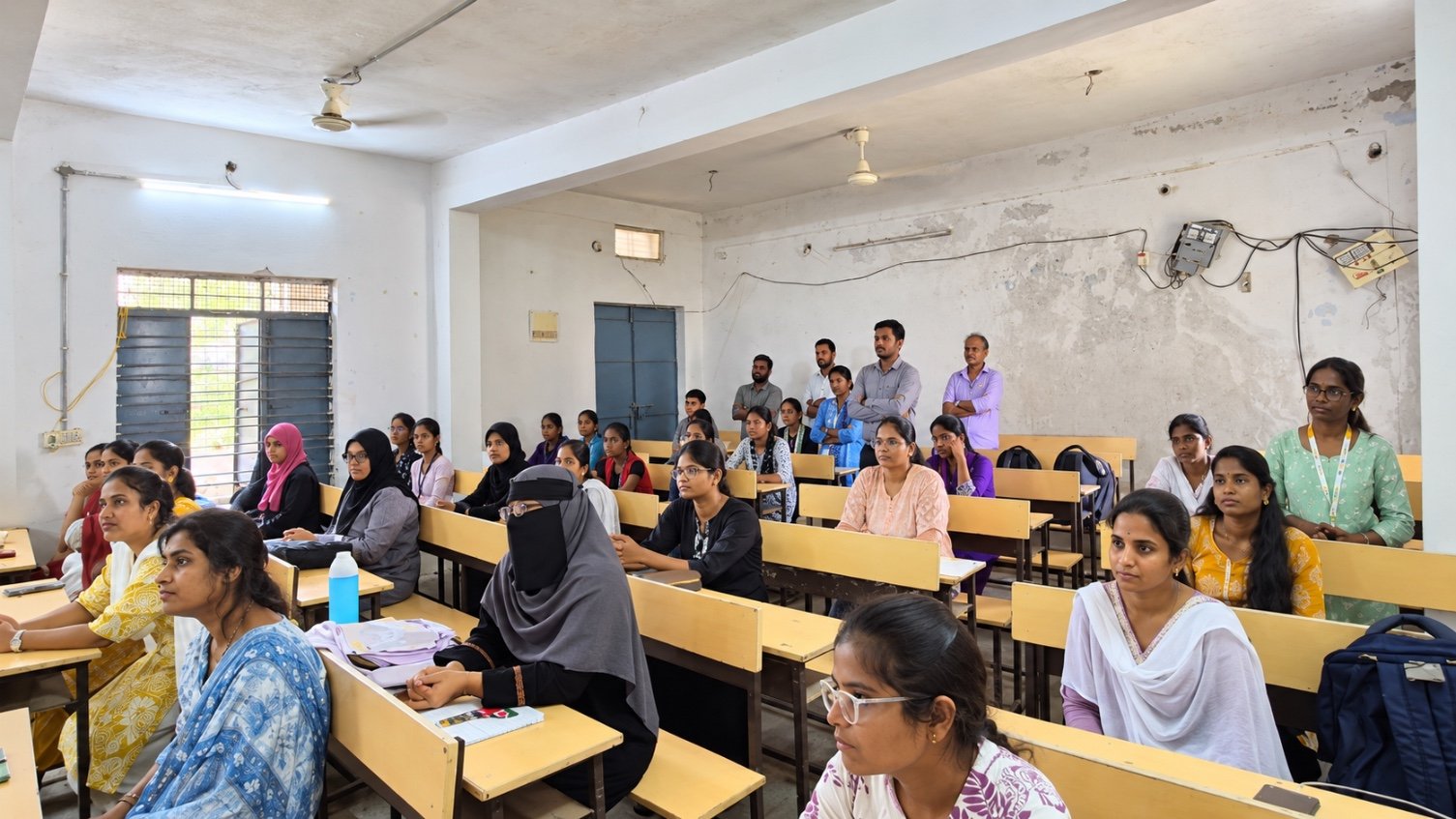
Four months, three hours a day, one very different year
The hardest year of a rural graduate’s life is usually the one immediately after the degree.
College ends in April. The certificate arrives. For a few weeks there is a sense of something achieved, and the family says so to everyone who visits. Then June comes, and the routine that structured the previous three years is simply gone, and nothing has replaced it.
What follows is difficult to describe to anyone who has not lived it. There is no timetable. There are applications, sent into forms that never reply. There is a cousin who says a relative might know someone. There are questions at home that start out gentle and do not stay gentle. There is a slow, corrosive recalculation in which a young person who was the pride of the household eleven months ago starts to wonder whether the degree was worth the money it cost.
Talent does not disappear in that year. Momentum does. Once momentum is gone, it is very hard to get back alone.
The graduate track within Skill Plus is built for exactly this year.
The arithmetic
Four months. About three hours a day. Somewhere between ninety and a hundred and twenty working days.
Run the multiplication and it comes to roughly three hundred hours of structured, supervised, employer-facing preparation. That is more focused contact time than most people get in a full year of a degree, compressed into a period short enough that a family can see the end of it from the beginning.
The three-hour design is not arbitrary. A graduate in the gap year is rarely idle. There is farm work, a shop, a sibling to drop at school, a temporary job that pays four hundred rupees a day and cannot be given up on the chance that a course works out. A full-time residential programme asks such a person to choose. Three hours a day, close to home, does not.
Who it is for
Take a composite. Call him Mahesh. Graduated fourteen months ago with a B.Sc. from a college about an hour from his village. Applied to eleven places, heard back from two, cleared neither first round. Currently helping at his uncle’s shop, which everyone including him describes as temporary.
Mahesh does not need three more years of education. He needs a specific set of things he was never taught: enough spoken English to get through a conversation with a stranger, practical computing, the reasoning formats that written screening rounds use, and a structured run at the workplace behaviour that no one in his family can coach him on because no one in his family has worked in an office.
He also needs the thing that is hardest to arrange for yourself: somewhere to be at ten in the morning, and people who expect him there.
The graduate track sits within Skill Plus rather than beside it. The final-year version of the programme runs alongside a degree, over a longer stretch. The graduate track covers comparable ground for people who have already left college, in a shorter and more concentrated form, and it can be run at remote centres that also serve graduates from neighbouring colleges — so distance is less often the reason someone drops out.
What the four months actually contain
The same working parts as the rest of Skill Plus, compressed and pitched at people who have already finished a degree and have a sharper idea of what they are missing.
Foundational English and communication, practised aloud every day, because the first round of most hiring processes is a conversation. Computing that is practical rather than theoretical. Reasoning and aptitude, in the formats that screening rounds actually use. Life skills, workplace readiness, and customised industry training aligned to sectors that are hiring within reach — ITES and BFSI to begin with.
What the schedule adds is less visible and probably more important. It restores a working shape to a day that had lost one. Graduates in these batches tend to arrive quiet and leave able to argue a point in front of a room, and the shift usually happens somewhere in month two, when enough small things have gone right that the person stops expecting to fail.
Honest about what we can and cannot say
We do not guarantee a job. Employers make that decision, and we are not going to pretend otherwise on our own website.
What the programme is designed to produce is a graduate who reaches the interview genuinely prepared, connected to employers through the network of the Deshpande Foundation, one of our founding partners, and aiming at entry-level roles in the Rs 2.5 to 3 lakh a year range. Part of the cost is contributed by the learner’s household, which we ask for deliberately: it keeps the programme accountable to families, and it keeps attendance honest.
We also think it is worth naming what the four months do for the people around the graduate. A household that has watched a young person drift for a year, and then watched them leave the house every morning with something to do, changes its own expectations. Younger siblings watch it happen. So do the neighbours’ children.
If the year after college is the one you are in
If you graduated in the last two or three years and the year since has looked anything like the one described here, this programme was designed with you in mind. You have not fallen behind permanently. You have lost a structure, and a structure can be rebuilt in four months.
If you are a college, an employer, or a community organisation that knows where these graduates are — and they are usually not hard to find, because they are at home — talk to us. The hardest part of running this track is not teaching it. It is reaching people who have quietly stopped believing that a programme like this is meant for them.
Together, that is a solvable problem.
Thanks for providing such a helpful and timely resource! I’m looking forward to reading more of your insights. I hope this is helpful! Let me know if you’d like me to make any adjustments or provide additional options.